



Private Custom Tour with a Local Guide
Alles über das Erlebnis
Triumphal Arch (Triumphpforte), Maria-Theresien-Strasse Maximilianstraße-Salurner Straße, Innsbruck 6020 Austria
The Triumphal Arch (German: Triumphpforte) is one of the best known sights in the Austrian city of Innsbruck. It is located at the southern end of the present Maria-Theresien-Straße, once the southern road out of the city.
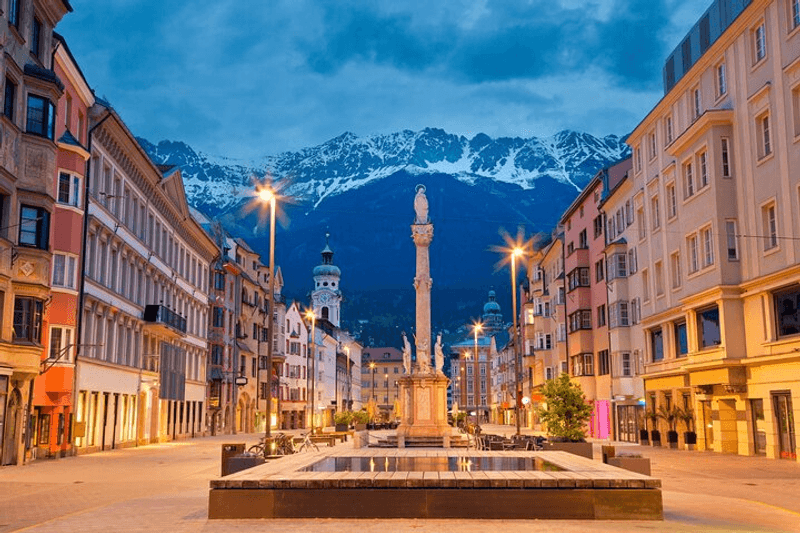
St. Anna's Column (Annasaule), Maria-Theresien-Strasse, Innsbruck Austria
St. Anne's Column (German: Annasäule) stands in the city centre of Innsbruck on Maria-Theresien-Straße.
It was given its name when, in 1703, the last Bavarian troops were driven from the Tyrol on St. Anne's Day (26 July), as part of the War of the Spanish Succession. In 1704, in gratitude, the Landstände vowed to build a monument commemorating the event.
Hofkirche Innsbruck, Universitaetsstrasse 2, Innsbruck 6020 Austria
The Hofkirche (Court Church) is a Gothic church located in the Altstadt (Old Town) section of Innsbruck, Austria. The church was built in 1553 by Emperor Ferdinand I (1503–1564) as a memorial to his grandfather Emperor Maximilian I (1459–1519), whose cenotaph within boasts a remarkable collection of German Renaissance sculpture. The church also contains the tomb of Andreas Hofer, Tyrol's national hero.
Town Tower (Stadtturm), Herzog-Friedrich-Strasse 21, Innsbruck 6020 Austria
The city tower is a somewhat protruding Gothic structure enclosed in the row of houses. Through the historic town hall you can reach the viewing platform located at a height of 31 meters, the total height of the tower is 51 meters. The massive quadrangular base consists of six floors and is divided altogether into three zones clearly delimited by kaffir cornices.
The Golden Roof (Goldenes Dachl), Duke Friedrich Street 15, Innsbruck 6020 Austria
The Goldenes Dachl (Golden Roof) is a landmark structure located in the Old Town (Altstadt) section of Innsbruck, Austria. It is considered the city's most famous symbol.Completed in 1500, the roof was decorated with 2,657 fire-gilded copper tiles for Emperor Maximilian I to mark his wedding to Bianca Maria Sforza. The Emperor and his wife used the balcony to observe festivals, tournaments, and other events that took place in the square below.